Home/Wiki/Retatrutide

Cell and tissue research

BPC-157

Cell movement and signalling in focus.

BPC-157 is a synthetic peptide of 15 amino acids. Research investigates cell adhesion, migration and stress responses.

BPC-157 BPC-157: FAK / paxillin. Preclinical indications; the complete chain of action remains unclear.
FAK / paxillinCell adhesion · cell movement

Tissue repair in models

Preclinical indications; the complete chain of action remains unclear. Simplified illustration; not to scale. Arrows indicate studied relationships, not proven clinical effects.

Simply explained

How it works: The complete chain of action of BPC-157 remains unclear. Preclinical models show changes in FAK and paxillin signals involved in cell attachment and movement.

Effects under investigation: Research examines cell migration, survival under stress and tendon and tissue repair processes. Cell and animal findings do not establish a healing effect in humans.

A mechanism does not establish clinical benefit.

Laboratory activity alone establishes neither efficacy nor safety in humans.

Mechanism of action

Changes in FAK–paxillin signalling were observed in rat tendon fibroblasts. This pathway links contacts with the cellular environment to the organisation of the cytoskeleton. These findings do not identify a definite primary target receptor.

Research status

The cited study uses cell cultures and tissue outside the organism. This is preclinical mechanism research.

Limits of the evidence

Cell and animal findings do not provide reliable evidence for treating injuries in humans.

Sources

Editorial update: 15 October 2026

Neurobiological research

DSIP

A research peptide with unanswered questions.

DSIP stands for Delta Sleep-Inducing Peptide. This nonapeptide is studied in relation to sleep and stress processes.

DSIP DSIP: Target structure unknown. Hypothesis: no single, clearly established receptor pathway.?
Target structure unknownSleep-related signalling

Sleep stages · stress responses

Hypothesis: no single, clearly established receptor pathway. Simplified illustration; not to scale. Arrows indicate studied relationships, not proven clinical effects.

Simply explained

How it works: No unified receptor pathway has been established for DSIP. Research explores possible links to the regulation of sleep and neuroendocrine processes.

Effects under investigation: Studies examine sleep stages, EEG activity and stress-related responses. Results are partly contradictory; the peptide’s name does not establish a reliable sleep-promoting effect.

A mechanism does not establish clinical benefit.

Laboratory activity alone establishes neither efficacy nor safety in humans.

Mechanism of action

The literature discusses several possible neuroendocrine connections. The selected studies do not establish a single, clearly understood receptor pathway. The historical name therefore does not describe a confirmed mechanism.

Research status

Experimental studies and a critical review report contradictory findings as well.

Limits of the evidence

Neither the name nor individual animal experiments establish a reliable sleep effect in humans.

Sources

Editorial update: 15 October 2026

Cell biology research

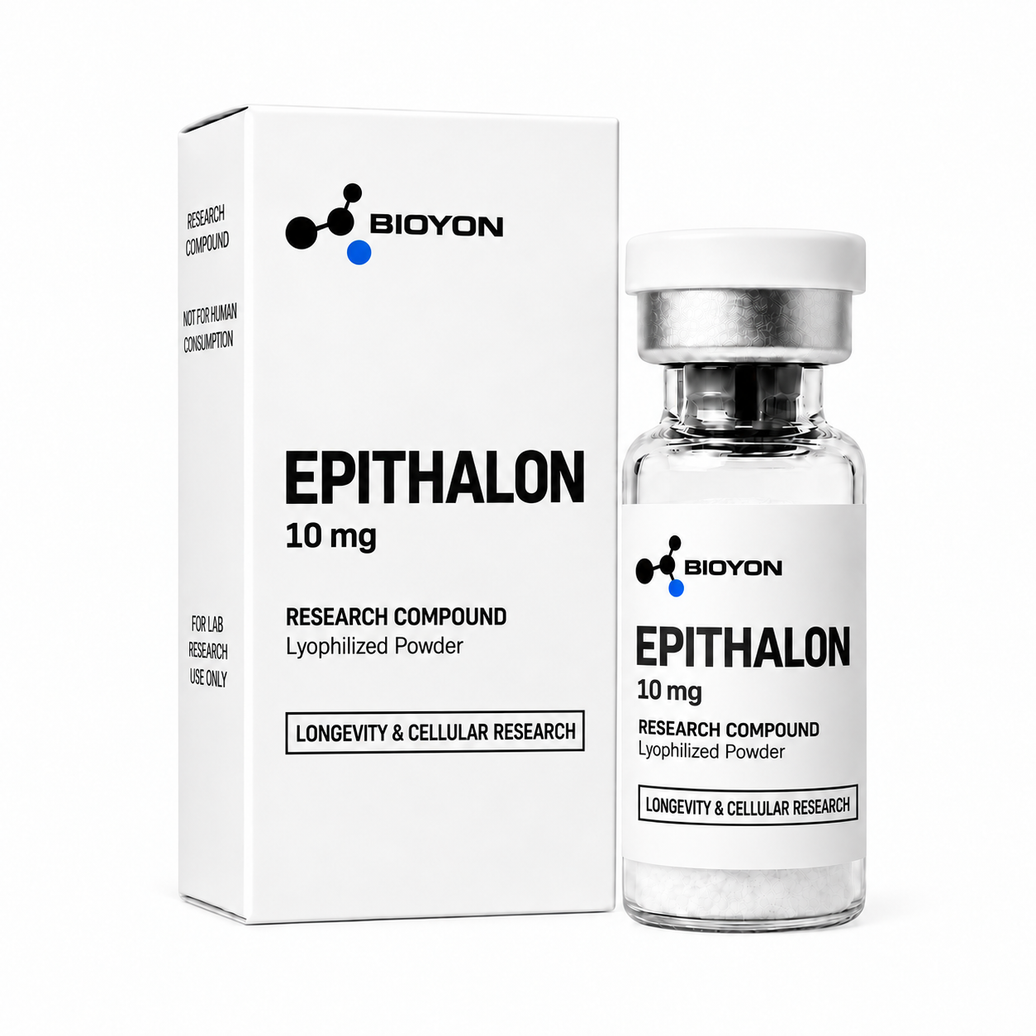
Epithalon

Exploring telomeres and gene regulation.

Epithalon, also called Epitalon, is a synthetic tetrapeptide studied in cellular models of telomere biology.

Epithalon Epithalon: Telomerase / hTERT. Cell findings; no evidence of human rejuvenation.
Telomerase / hTERTMaintenance of chromosome ends

Telomere length in cell cultures

Cell findings; no evidence of human rejuvenation. Simplified illustration; not to scale. Arrows indicate studied relationships, not proven clinical effects.

Simply explained

How it works: Epithalon is studied in connection with telomerase. This enzyme helps maintain telomeres, the protective regions at chromosome ends. Cell studies describe changes in hTERT expression and telomerase activity.

Effects under investigation: Research examines telomere length and cellular ageing in specific cell cultures. These laboratory findings establish neither rejuvenation nor a longer human lifespan.

A mechanism does not establish clinical benefit.

Laboratory activity alone establishes neither efficacy nor safety in humans.

Mechanism of action

Changes in hTERT expression, telomerase activity and telomere length have been described in certain human cell cultures. The mechanisms involved may depend on the cell type.

Research status

The linked studies examine cultured cells. They allow analysis of cellular processes, not conclusions about extending human life.

Limits of the evidence

Telomere length is not a simple measure of health or lifespan. Cell findings do not establish an anti-ageing effect.

Sources

Editorial update: 15 October 2026

Copper peptide

GHK-Cu

A tripeptide that binds copper.

GHK-Cu is the copper complex of glycyl-L-histidyl-L-lysine. Copper binding is an important part of its biochemical properties.

GHK-Cu GHK-Cu: Copper binding. Simplified illustration of processes studied in cell models.
Copper bindingConnective-tissue cell responses

Collagen synthesis · matrix remodelling

Simplified illustration of processes studied in cell models. Simplified illustration; not to scale. Arrows indicate studied relationships, not proven clinical effects.

Simply explained

How it works: GHK-Cu consists of a short peptide and a bound copper ion. Studies in fibroblasts, or connective-tissue cells, investigate how this complex affects the formation of components around cells.

Effects under investigation: Research focuses on collagen synthesis and tissue remodelling. The linked original study reports cell-culture findings; it does not establish a cosmetic or medical effect of the research product.

A mechanism does not establish clinical benefit.

Laboratory activity alone establishes neither efficacy nor safety in humans.

Mechanism of action

An influence on collagen synthesis has been investigated in fibroblast cultures. The observed responses concern the extracellular matrix, the material between cells. They cannot be reduced to one universal receptor.

Research status

The selected original study describes a fibroblast cell-culture model.

Limits of the evidence

Cellular collagen synthesis does not establish a particular cosmetic or medical effect of a research product.

Sources

Editorial update: 15 October 2026

Peptide blends

GLOW

Understanding the individual components.

GLOW is a blend of GHK-Cu, BPC-157 and TB-500 offered in the BIOYON range.

GLOW GLOW: GHK-Cu, BPC-157, TB-500. No established shared chain of action or synergy of the blend.
GHK-CuMatrix formation
BPC-157Cell adhesion
TB-500Tβ4-related processes

Individual components studied separately

No established shared chain of action or synergy of the blend. Simplified illustration; not to scale. Arrows indicate studied relationships, not proven clinical effects.

Simply explained

How it works: GLOW combines GHK-Cu, BPC-157 and TB-500. Copper-dependent matrix formation, cell adhesion and thymosin-β4-related processes are studied for the individual components. This does not establish a shared mechanism of the blend.

Effects under investigation: Research on individual components examines collagen synthesis, cell migration and tissue repair in experimental models. These results establish neither an enhanced effect nor clinical activity of the offered blend.

A mechanism does not establish clinical benefit.

Laboratory activity alone establishes neither efficacy nor safety in humans.

Mechanism of action

Different mechanisms are discussed for the components: copper binding and matrix processes for GHK-Cu, preclinical cellular responses for BPC-157 and thymosin-β4-related research for TB-500.

Research status

The linked sources concern individual components. They do not establish efficacy of the offered blend.

Limits of the evidence

No synergy or clinical superiority of this combination is claimed here. For TB-500 in particular, the specific sequence must match the substance studied.

Sources

Editorial update: 15 October 2026

Receptor agonists

Ipamorelin

Understanding ghrelin signalling.

Ipamorelin is a synthetic pentapeptide in the growth hormone secretagogue group. It is associated with the ghrelin/GHS receptor system.

Ipamorelin Ipamorelin: Ghrelin / GHS receptor. Receptor activation; no conclusion about muscle growth.
Ghrelin / GHS receptorPituitary signalling

Growth hormone release

Receptor activation; no conclusion about muscle growth. Simplified illustration; not to scale. Arrows indicate studied relationships, not proven clinical effects.

Simply explained

How it works: Ipamorelin targets the ghrelin/growth hormone secretagogue receptor system and can stimulate growth hormone release. It uses a different receptor from GHRH analogues such as tesamorelin.

Effects under investigation: Research examines growth hormone responses and selectivity relative to other hormonal reactions. Early characterisation uses experimental models; it does not establish an effect on muscle growth or recovery.

A mechanism does not establish clinical benefit.

Laboratory activity alone establishes neither efficacy nor safety in humans.

Mechanism of action

Ipamorelin acts through the growth hormone secretagogue receptor system, which differs from the GHRH receptor system. Early pharmacological studies examined growth hormone release and selectivity relative to other hormone responses.

Research status

The original study describes pharmacological investigations in experimental models.

Limits of the evidence

Selectivity in an experimental model does not guarantee the absence of unwanted effects in humans.

Sources

Editorial update: 15 October 2026

Peptide blends

KLOW

Understanding the individual components.

KLOW is a blend of GHK-Cu, BPC-157, TB-500 and KPV offered in the BIOYON range.

KLOW KLOW: GHK-Cu, BPC-157, TB-500, KPV. No established shared chain of action or synergy of the blend.
GHK-CuMatrix formation
BPC-157Cell adhesion
TB-500Tβ4 connection
KPVPepT1 uptake

Individual components studied separately

No established shared chain of action or synergy of the blend. Simplified illustration; not to scale. Arrows indicate studied relationships, not proven clinical effects.

Simply explained

How it works: KLOW combines GHK-Cu, BPC-157, TB-500 and KPV. The individual components represent different research approaches, including matrix formation, cell adhesion, thymosin-β4-related processes and KPV uptake through a peptide transporter.

Effects under investigation: Research on individual components examines collagen synthesis, cell migration and inflammation-related cellular responses. This does not establish synergy or clinical activity of the specific blend.

A mechanism does not establish clinical benefit.

Laboratory activity alone establishes neither efficacy nor safety in humans.

Mechanism of action

Different mechanisms are discussed for the components: copper binding and matrix processes for GHK-Cu, preclinical cellular responses for BPC-157 and thymosin-β4-related research for TB-500. KPV is studied in connection with peptide transport.

Research status

The linked sources concern individual components. They do not establish efficacy of the offered blend.

Limits of the evidence

No synergy or clinical superiority of this combination is claimed here. For TB-500 in particular, the specific sequence must match the substance studied.

Sources

Editorial update: 15 October 2026

Peptide transport

KPV

Three amino acids and a transport pathway.

KPV is a tripeptide made of lysine, proline and valine. It is studied in models of inflammation-related signalling.

KPV KPV: PepT1 transporter. Cell and animal models; no established human treatment.
PepT1 transporterUptake into certain cells

Inflammation-related cellular responses

Cell and animal models; no established human treatment. Simplified illustration; not to scale. Arrows indicate studied relationships, not proven clinical effects.

Simply explained

How it works: The peptide transporter PepT1 can take KPV into certain cells. Influences on inflammation-related signalling have been investigated there.

Effects under investigation: Cell and mouse studies examine inflammatory messenger release and changes in experimental intestinal inflammation models. These results do not confirm a treatment option in humans.

A mechanism does not establish clinical benefit.

Laboratory activity alone establishes neither efficacy nor safety in humans.

Mechanism of action

An original study examines KPV uptake through the peptide transporter PepT1. After uptake, changes in inflammation-related pathways and cytokine release were investigated.

Research status

The linked study combines cellular models with experimental inflammation models in mice.

Limits of the evidence

Uptake and signalling changes in a model do not establish a treatment option in humans.

Sources

Editorial update: 15 October 2026

Melanocortin system

Melanotan II

An analogue of α-MSH.

Melanotan II is a cyclic peptide analogue of the body’s own melanocortin α-MSH.

Melanotan II Melanotan II: Melanocortin receptors. Different receptors and models; no proof of UV protection.
Melanocortin receptorsTissue-dependent signalling

Pigmentation · appetite signals

Different receptors and models; no proof of UV protection. Simplified illustration; not to scale. Arrows indicate studied relationships, not proven clinical effects.

Simply explained

How it works: Melanotan II resembles the body’s signalling peptide α-MSH and activates melanocortin receptors. Different responses can arise depending on the receptor and tissue.

Effects under investigation: Research examines skin pigmentation and appetite-related responses. Pigmentation findings include a small clinical pilot study; the linked appetite study examines mice. This establishes neither reliable UV protection nor a general clinical benefit.

A mechanism does not establish clinical benefit.

Laboratory activity alone establishes neither efficacy nor safety in humans.

Mechanism of action

It is studied as an agonist at melanocortin receptors. This receptor family participates in different processes, so an observed response depends on which receptor is activated in which tissue.

Research status

The selected early study includes in-vitro findings and a small clinical pilot study.

Limits of the evidence

A small pilot study cannot comprehensively establish safety or benefit. A pigmentation response does not mean reliable protection against UV radiation.

Sources

Editorial update: 15 October 2026

Mitochondrial signalling

MOTS-C

Communication between mitochondria and the cell.

MOTS-C is a mitochondrially derived peptide of 16 amino acids. Research investigates its role in metabolic stress responses.

MOTS-C MOTS-C: AMPK / nucleus. Preclinical connections; not a depiction of a single receptor.
AMPK / nucleusEnergy stress · gene regulation

Glucose utilisation in models

Preclinical connections; not a depiction of a single receptor. Simplified illustration; not to scale. Arrows indicate studied relationships, not proven clinical effects.

Simply explained

How it works: MOTS-C is a mitochondrially derived signalling peptide. Cell and animal studies link it to the energy sensor AMPK; effects on gene regulation in the nucleus have also been studied under metabolic stress.

Effects under investigation: Research focuses on glucose utilisation, insulin sensitivity and adaptations to metabolic stress. The described preclinical findings do not establish improved performance or metabolic health in humans.

A mechanism does not establish clinical benefit.

Laboratory activity alone establishes neither efficacy nor safety in humans.

Mechanism of action

Studies describe connections to folate and purine metabolism and the energy sensor AMPK. Under metabolic stress, movement into the nucleus and involvement in gene regulation have also been investigated.

Research status

The linked original studies investigate molecular mechanisms in cell and animal models.

Limits of the evidence

Changes in AMPK or gene expression do not directly establish human performance or metabolic health effects.

Sources

Editorial update: 15 October 2026

Melanocortin system

PT-141

Receptor activation by bremelanotide.

PT-141 is also known as bremelanotide. This cyclic peptide belongs to the melanocortin receptor agonists.

PT-141 PT-141: Melanocortin / MC4 receptor. The exact mechanism of the clinical effect remains unclear.
Melanocortin / MC4 receptorNeuronal signal transmission

Sexual desire in studies

The exact mechanism of the clinical effect remains unclear. Simplified illustration; not to scale. Arrows indicate studied relationships, not proven clinical effects.

Simply explained

How it works: PT-141, also called bremelanotide, activates melanocortin receptors. Structural studies show binding to the MC4 receptor and subsequent signal transmission into the cell.

Effects under investigation: Research examines neuronal responses and changes in sexual desire in clinical studies of a defined medicine. The exact mechanism of this clinical effect is not fully understood; medicine data do not establish suitability of the offered research material.

A mechanism does not establish clinical benefit.

Laboratory activity alone establishes neither efficacy nor safety in humans.

Mechanism of action

Structural and functional studies show bremelanotide binding to the melanocortin-4 receptor (MC4R) and coupling to Gs proteins. This illustrates how binding outside a cell can trigger a signal inside it.

Research status

The selected study combines high-resolution receptor structures with pharmacological tests.

Limits of the evidence

A receptor finding does not amount to approval or medical suitability of the research material sold in the shop.

Sources

Editorial update: 15 October 2026

Receptor agonists

Retatrutide

One molecule. Three receptor targets.

Retatrutide is studied as an agonist at GIP, GLP-1 and glucagon receptors. It combines three receptor targets in one synthetic peptide.

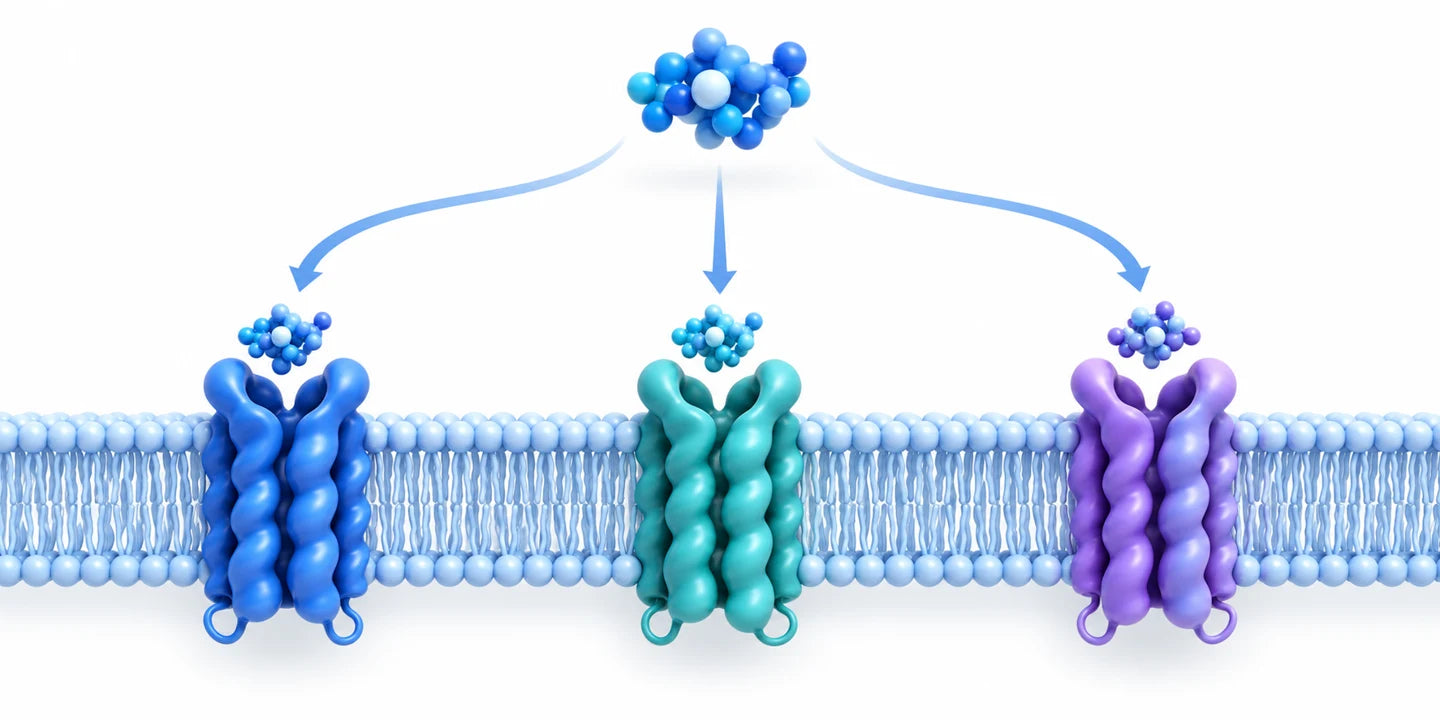
RetatrutideSchematic illustration: retatrutide targets GIP, GLP-1 and glucagon receptors.
GIP receptorGLP-1 receptorGlucagon receptor
Simplified illustration of the three receptor targets. Not to scale. The three branches show different target receptors, not a sequence.

Simply explained

How it works: Retatrutide activates GIP, GLP-1 and glucagon receptors. These receptors transmit signals into cells and influence processes including metabolism.

Effects under investigation: Studies examine blood glucose regulation, body weight and energy expenditure. There are cell, animal and clinical studies using defined study preparations; these do not establish equivalence of the offered research material.

A mechanism does not establish clinical benefit.

Laboratory activity alone establishes neither efficacy nor safety in humans.

Mechanism of action

All three targets are G-protein-coupled receptors. Activation can stimulate production of the cellular messenger cAMP through Gs proteins. Structural studies show how retatrutide recognises the different binding sites.

Research status

Cryo-electron microscopy and cell-based tests investigate binding and receptor activity. There are also clinical studies with defined study preparations. These different levels of investigation answer different questions.

Limits of the evidence

A receptor structure explains a molecular mechanism. By itself, it establishes neither clinical benefit nor safety of research material sold in the shop.

Sources

Editorial update: 15 October 2026

Neurobiological research

Selank

Neurotransmitter systems in a model.

Selank is a synthetic heptapeptide derived from the peptide tuftsin.

Selank Selank: GABA system. A proposed mechanism, not a confirmed direct chain of action.
GABA systemPossible receptor modulation

Anxiety- / stress-related responses

A proposed mechanism, not a confirmed direct chain of action. Simplified illustration; not to scale. Arrows indicate studied relationships, not proven clinical effects.

Simply explained

How it works: A change in GABA receptor responses is discussed for Selank. GABA is an inhibitory messenger in the nervous system. Experimental findings suggest Selank might influence how certain receptors respond to this signal.

Effects under investigation: Research examines GABA binding and anxiety- or stress-related responses. The mechanism is not conclusively understood; experimental indications do not establish an anxiety-reducing effect in humans.

A mechanism does not establish clinical benefit.

Laboratory activity alone establishes neither efficacy nor safety in humans.

Mechanism of action

An experimental study describes possible allosteric modulation of GABA receptors. Allosteric means influencing a receptor’s response without simply replacing the action of its usual messenger.

Research status

The cited mechanistic study provides experimental indications for a hypothesis; it does not establish a complete universal mechanism.

Limits of the evidence

A receptor model does not establish anxiety-reducing or cognitive effects of a research product.

Sources

Editorial update: 15 October 2026

Neurobiological research

Semax

Neurotrophins and gene expression.

Semax is a synthetic, ACTH-derived heptapeptide studied in neurobiological models.

Semax Semax: BDNF-related pathways. Observations in rats; direct receptor mechanism unknown.
BDNF-related pathwaysGene expression in nervous tissue

Nerve-cell adaptation

Observations in rats; direct receptor mechanism unknown. Simplified illustration; not to scale. Arrows indicate studied relationships, not proven clinical effects.

Simply explained

How it works: Semax is an ACTH-derived peptide. Rat studies observed changes in BDNF production, a signalling protein involved in nerve-cell function and adaptability. This does not establish a complete direct receptor mechanism.

Effects under investigation: Research examines neurotrophic pathways and changes in BDNF expression in brain regions. These animal findings do not establish improved memory or concentration in humans.

A mechanism does not establish clinical benefit.

Laboratory activity alone establishes neither efficacy nor safety in humans.

Mechanism of action

A rat study described changes in expression of the neurotrophic factor BDNF in brain regions. Such findings concern downstream cellular responses and do not automatically identify a direct target receptor.

Research status

The selected original study examines BDNF expression in an animal model.

Limits of the evidence

Animal changes in BDNF do not establish improved human memory or concentration.

Sources

Editorial update: 15 October 2026

GHRH system

Sermorelin

The active GHRH fragment.

Sermorelin corresponds to the amidated GHRH fragment containing the first 29 amino acids.

Sermorelin Sermorelin: GHRH receptor. Simplified illustration of GHRH signalling.
GHRH receptorPituitary signalling

Growth hormone release

Simplified illustration of GHRH signalling. Simplified illustration; not to scale. Arrows indicate studied relationships, not proven clinical effects.

Simply explained

How it works: Sermorelin corresponds to an active segment of the body’s GHRH. It activates GHRH receptors in the pituitary gland and can stimulate growth hormone release.

Effects under investigation: Research examines growth hormone responses and peptide segments essential for receptor activation. This does not generally establish effects on body composition or performance.

A mechanism does not establish clinical benefit.

Laboratory activity alone establishes neither efficacy nor safety in humans.

Mechanism of action

The fragment activates the GHRH receptor. Structure–activity studies examine which peptide segments are important for receptor activation. This receptor participates in regulation of the growth hormone axis.

Research status

The selected original study investigates relationships between peptide structure and receptor activation.

Limits of the evidence

An active fragment is not general evidence for tolerability or a specific effect of a research product.

Sources

Editorial update: 15 October 2026

Cell and tissue research

TB-500

Distinguishing thymosin-β4 from fragments.

The name TB-500 is used for synthetic, thymosin-β4-related peptides. The actual sequence is decisive.

TB-500 TB-500: Connection to thymosin-β4. Tβ4 findings cannot be indiscriminately transferred to TB-500 fragments.
Connection to thymosin-β4Actin / cytoskeleton with full Tβ4

Cell movement · tissue repair

Tβ4 findings cannot be indiscriminately transferred to TB-500 fragments. Simplified illustration; not to scale. Arrows indicate studied relationships, not proven clinical effects.

Simply explained

How it works: The exact peptide sequence is decisive for TB-500. Full-length thymosin-β4 binds actin, a component of the cytoskeleton. A fragment described as TB-500 is not automatically biologically equivalent.

Effects under investigation: Thymosin-β4 research focuses on actin organisation, cell movement and tissue repair. These findings must not be indiscriminately transferred to TB-500 fragments. The specific material’s mechanism remains open without appropriate identity and function data.

A mechanism does not establish clinical benefit.

Laboratory activity alone establishes neither efficacy nor safety in humans.

Mechanism of action

Full-length thymosin-β4 binds monomeric actin, a component of the cytoskeleton. An analytical TB-500 study instead described a synthetic fragment with the sequence LKKTETQ. Mechanisms of the full protein must not be indiscriminately attributed to a fragment.

Research status

The sources concern actin binding by thymosin-β4 and analytical identification of a TB-500 preparation.

Limits of the evidence

Without confirmed sequence identity, literature findings can only be attributed to the specific material to a limited extent. They do not establish a regenerative effect.

Sources

Editorial update: 15 October 2026

GHRH system

Tesamorelin

Reproducing GHRH signalling.

Tesamorelin is a synthetic analogue of growth hormone-releasing hormone, or GHRH.

Tesamorelin Tesamorelin: GHRH receptor. Simplified hormonal signal; no general weight-loss claim.
GHRH receptorPituitary → growth hormone

Downstream IGF-1 response

Simplified hormonal signal; no general weight-loss claim. Simplified illustration; not to scale. Arrows indicate studied relationships, not proven clinical effects.

Simply explained

How it works: Tesamorelin reproduces the body’s GHRH signal. It activates GHRH receptors in the pituitary, stimulates growth hormone release and can thereby affect the downstream growth factor IGF-1.

Effects under investigation: Defined medicines are used to investigate growth hormone and IGF-1 responses and changes in visceral abdominal fat in HIV-associated lipodystrophy. This does not establish a general weight-loss effect or medical suitability of the research material.

A mechanism does not establish clinical benefit.

Laboratory activity alone establishes neither efficacy nor safety in humans.

Mechanism of action

Tesamorelin binds to and activates the human GHRH/GRF receptor. This system regulates growth hormone production and pulsatile release in somatotropic pituitary cells. It differs from the ghrelin receptor system.

Research status

The linked prescribing information for a defined medicine describes the receptor mechanism and clinical pharmacology.

Limits of the evidence

Medicine data apply to the preparation evaluated there. They do not establish equivalence or suitability of research material offered in the shop.

Sources

Editorial update: 15 October 2026

Immune cell research

Thymosin-Alpha 1

Signalling in dendritic cells.

Thymosin-Alpha 1 is a peptide of 28 amino acids, studied in connection with immune cell regulation.

Thymosin-Alpha 1 Thymosin-Alpha 1: Toll-like receptor pathways. Experimental models; responses depend on cell state.
Toll-like receptor pathwaysDendritic cells

Maturation · immune messengers

Experimental models; responses depend on cell state. Simplified illustration; not to scale. Arrows indicate studied relationships, not proven clinical effects.

Simply explained

How it works: Thymosin-Alpha 1 is studied as a regulator of immune cell responses. Experimental models describe Toll-like receptor-dependent signals and changes in dendritic cells, which provide information to other immune cells.

Effects under investigation: Research examines maturation of these cells, production of messengers such as interleukin-12 and coordination of certain immune responses. This does not mean a general ‘immune boost’; responses depend on the model and cell state.

A mechanism does not establish clinical benefit.

Laboratory activity alone establishes neither efficacy nor safety in humans.

Mechanism of action

Experimental studies describe involvement of Toll-like receptor-dependent pathways in dendritic cell responses. These cells process information about potential pathogens and influence further immune responses.

Research status

The selected original study examines dendritic cells and an experimental immune response.

Limits of the evidence

Immunomodulation does not simply mean general strengthening of the immune system. Effects depend on the model and state of the cells.

Sources

Editorial update: 15 October 2026

Receptor agonists

Tirzepatide

Two receptor targets in one peptide.

Tirzepatide is a synthetic peptide with agonist activity at GIP and GLP-1 receptors.

Tirzepatide Tirzepatide: GIP receptor, GLP-1 receptor. Two receptor targets; no conclusion about suitability of the research product.
GIP receptorMetabolic signalling
GLP-1 receptorMetabolic signalling

Insulin responses · food intake

Two receptor targets; no conclusion about suitability of the research product. Simplified illustration; not to scale. Arrows indicate studied relationships, not proven clinical effects.

Simply explained

How it works: Tirzepatide activates GIP and GLP-1 receptors. These pathways participate in processes including glucose-dependent insulin responses and regulation of food intake.

Effects under investigation: Research examines blood glucose regulation, body weight and molecular binding to both receptors. Results from defined medicines or study preparations do not establish equivalence or medical suitability of a research product.

A mechanism does not establish clinical benefit.

Laboratory activity alone establishes neither efficacy nor safety in humans.

Mechanism of action

Structural studies show binding to both receptors. Activation is investigated through pathways including Gs-coupled signalling. Unlike retatrutide, the glucagon receptor is not an additional target of this dual agonism.

Research status

The selected study links receptor structures with pharmacological measurements.

Limits of the evidence

Receptor activity and clinical effects are different levels of investigation. Medicine findings must not be indiscriminately transferred to research reagents.

Sources

Editorial update: 15 October 2026

Terms explained clearly
Agonist
A molecule that binds to a receptor and activates it.
Receptor
A structure that recognises signals and can mediate a cellular response.
Preclinical
Studies in, for example, cell cultures, tissues or animal models.